
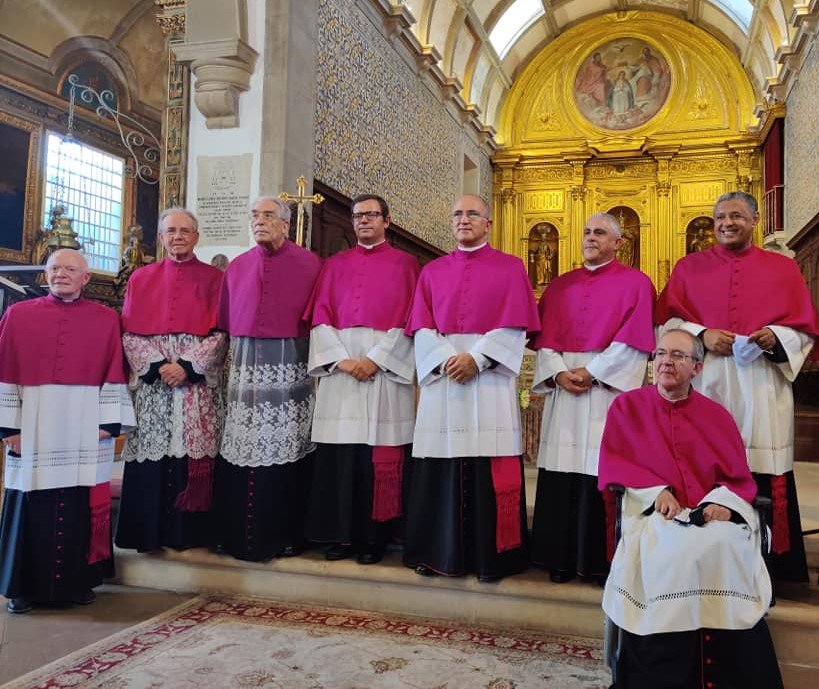
Current Chapter Composition
Dean: Canon Doutor Mário José Rodrigues de Sousa
Precentor and Secretary: Canon Dr. Carlos Manuel Patrício de Aquino
Archdeacon and Tresasurer: Canon Dr. Rui José Barros Guerreiro
Canon Penitentiary: Canon Dr. Rui José Barros Guerreiro
Other Canons:
Canon Eng. Carlos Alberto César Morais Chantre
Canon Manuel de Oliveira Rodrigues
Canon Dr. Joaquim José Duarte Nunes
Retired / Canon Emeritus:
Canon Dr. Joaquim Luís Cupertino
Canon José Rosa Simão
The Chapter Room
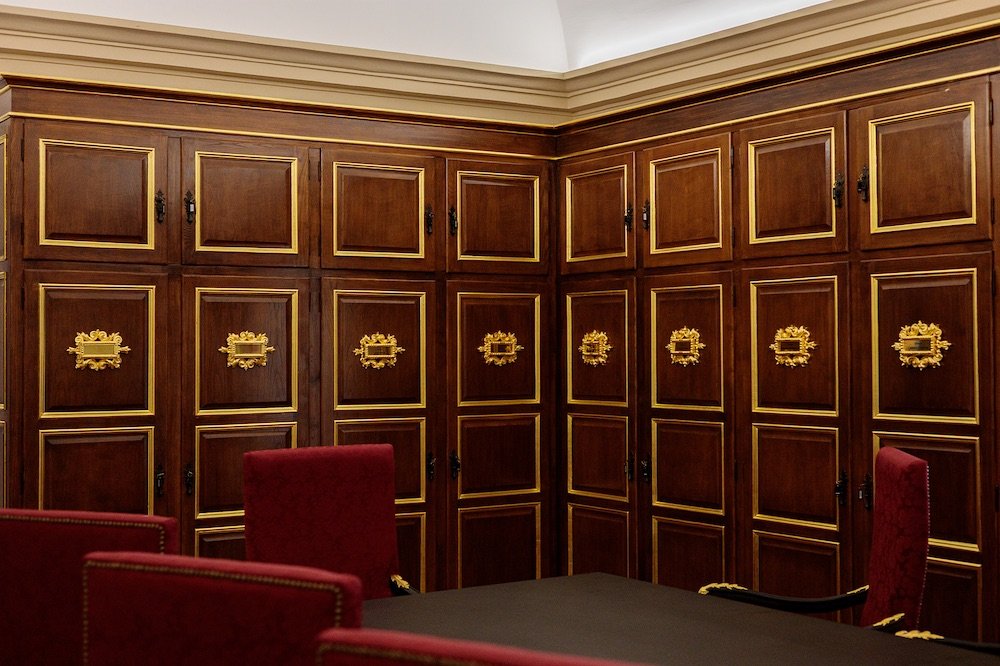
The meeting space for the Cathedral Chapter of canons, the body responsible for the liturgy, administration, and preservation of the Cathedral. The table and chairs—where the Dean (President of the Chapter), the Precentor (responsible for the Cathedral’s liturgy), the Archdeacon (responsible for administration), and the other canons sit—rest upon a Persian carpet (Najafabad Patina).
Within the recessed niche stands an 18th-century statue of Our Lady of the Rosary. The “Adoration of the Magi” canvas and the cabinet-on-stand (contador) both date from the 19th century and are of Spanish origin. Along the side walls are the chapter cupboards, assigned to each canon. At the centre of the vaulted ceiling is the coat of arms of the Faro Cathedral Chapter
The Cathedral Chapter
It is a widely held view that Christianity first entered Portugal through the region now known as the Algarve. In 303 AD, Bishop Vincent of Ossónoba (modern-day Faro) signed the acts of the Council of Elvira, signifying that a structured Church existed in the Algarve territory at least as early as the 3rd century.
The origins of the Chapter in the Diocese of the Algarve are uncertain. However, it is known that following the creation of the Diocese of Silves in 1189, it was instituted with its own statutes confirmed by the Holy See. In 1539, Pope Paul III published the Papal Bull decreeing the transfer of the episcopal see to Faro, moving the Cathedral to the Parish Church of Saint Mary. The following year, King John III elevated Faro to the status of a city, a title befitting its new position as the seat of the Bishopric.
The move to Faro was completed in 1577, during the tenure of the humanist Bishop of the Algarve, Dom Jerónimo Osório. While in Faro on Good Friday of that year, he chose not to return to Silves for the solemnities, celebrating them instead at Saint Mary’s, the new Cathedral. In doing so, he enacted the 1539 Bull.
Thus, on 30 March 1577, the Chapter, alongside Dom Jerónimo Osório, officiated for the first time in the new Cathedral. In accordance with Canon 503 of the Code of Canon Law, the Cathedral Chapter of Faro comprises a College of Priests which, upholding an ancient tradition of the Western Churches, serves the Diocesan Church of the Algarve and its Bishop through Divine Worship and Ministry, governed by its own internal statutes.
It consists of six Capitular Canons, three of whom hold Dignities and take precedence in the following order: the Dean, the Precentor, the Archdeacon of the Cathedral, and all other Canons, ranked among themselves by seniority.
The Chapter is not subject to a numerus clausus (fixed limit); its statutes dictate that the body should consist of six canons under the age of 75, presided over by a Dean, assisted by the Precentor (liturgy) and the Archdeacon (heritage).
Upon reaching the age of seventy-five, members are invited to petition the Diocesan Bishop for retirement. Once the Prelate accepts their resignation, they move to the status of Canons Emeritus. As a consultative body, the Chapter plays a vital role in the Diocese, safeguarding its heritage and promoting the evangelisation of culture.
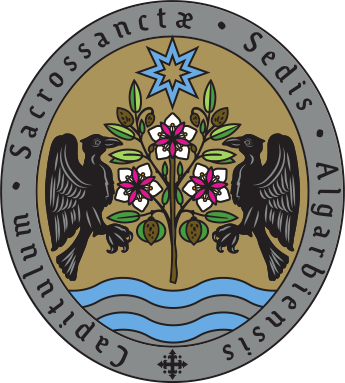
The coat of arms of the Chapter of the Diocese of the Algarve is a symbol of faith, tradition, and the Chapter’s pastoral mission, reflecting Christian values and the history of the Diocese. Its elements are as follows:
– The Ravens: Represent Saint Vincent, the patron saint of the Diocese of the Algarve.
– The Blue Star: Symbolises Saint Mary of Faro, to whom the city was dedicated. It recalls the miracle attributed to her during the Moorish period, as recorded in the Cantigas of King Alfonso X, ‘the Wise’. The image of Saint Mary was placed upon the city walls, being of paramount importance to the resident Christian community. Following a conflict between Christians and Muslims, the image was thrown into the sea by the latter. From that moment on, whenever the fishermen went to sea, their nets came back empty. The Moors viewed this as divine punishment and decided to recover the image from the sea and restore it to the walls. Thereafter, the fishing became once again abundant.
– The Flowering Almond Branch: This carries a dual meaning: it refers to Saint Mary as the pinnacle of the Tree of Jesse, from which the Saviour, Jesus Christ, is born and the fruits of the Holy Church grow; it also identifies the region, as almond trees are a characteristic and abundant crop of the Algarve.
«…thou mayest know how thou oughtest to behave thyself in the house of God, which is the church of the living God, the pillar and ground of the truth»
This is a call to the way of serving, safeguarding, and advising on the life of the Church and Communion. The Chapter is to be an image of this within the diocesan context, for the Glory of the Church, the faithful, and their Bishop.